
A journey through faith, history, and architecture along Malaysia’s east coast
It’s not difficult to find mosques in Malaysia. From quiet kampung streets to city centres bustling with activity, these sacred places of worship are part of everyday life. While many take on humble forms in neighbourhoods closer to home, there are also mosques that stand out as stunning architectural marvels.
Terengganu is often known for its islands, beaches, and quiet coastal charm. But beyond the turquoise waters lies another side of the state that many travellers overlook, its beautiful mosques.
Scattered across towns like Kuala Terengganu, Kemaman, Dungun, Besut, Setiu, and Kuala Nerus, these mosques are more than places of worship. They reflect Terengganu’s identity, blending Islamic heritage, local craftsmanship, and architectural expressions shaped by time.
Here are 12 mosques in Terengganu you should visit at least once.
1. Tengku Tengah Zaharah Mosque (Floating Mosque), Kuala Terengganu


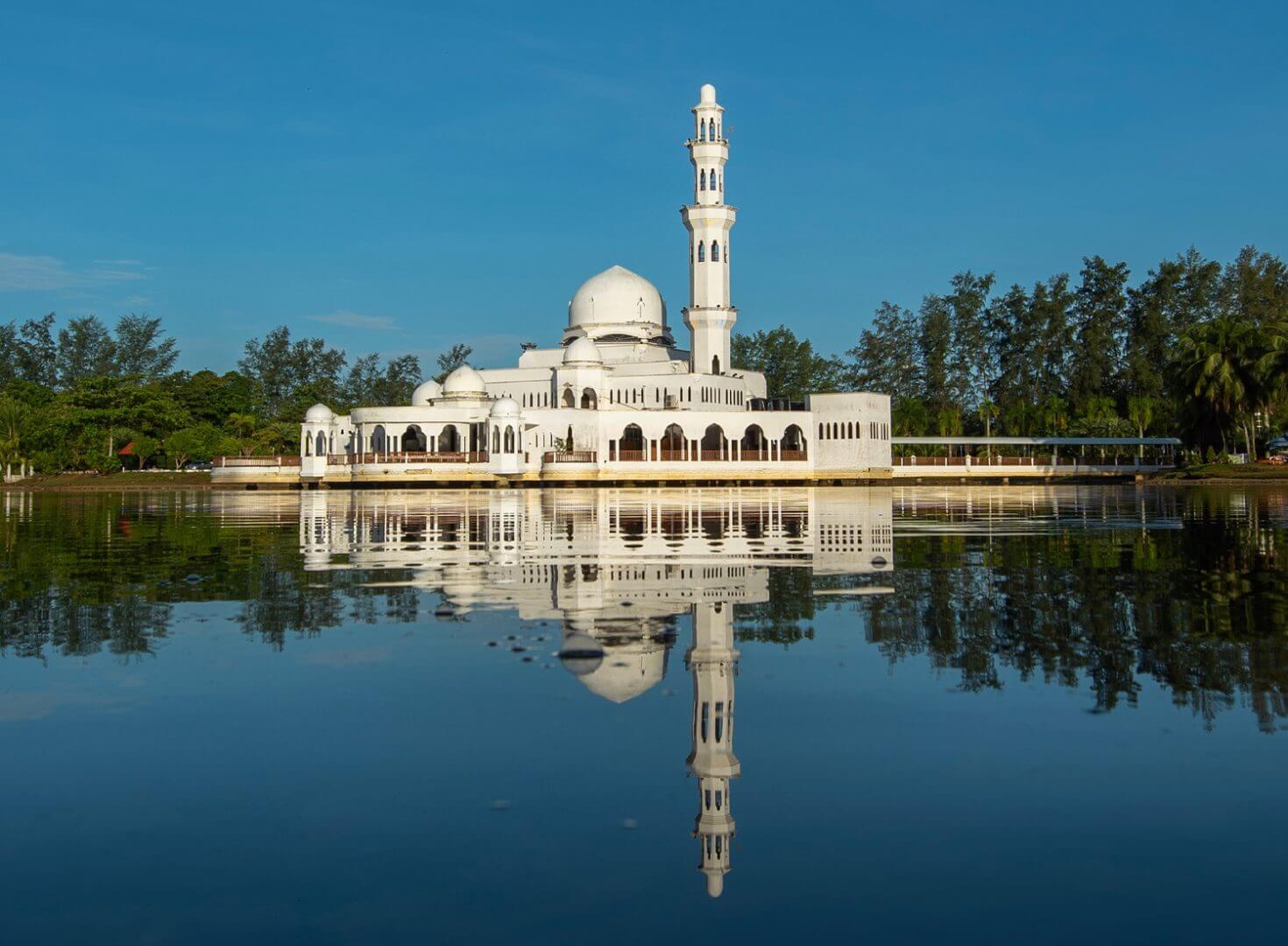
Built over the river in 1995 and named after the mother of the Sultan of Terengganu, the Tengku Tengah Zaharah Mosque is famously known as the Floating Mosque, as it appears to hover above a man-made lagoon.
Located slightly outside the main city, it offers a quieter, more peaceful atmosphere. While modest in size, its surroundings make it incredibly calming.
Its blend of Moorish and modern Islamic architecture makes it one of the most photogenic mosques in Malaysia, especially during sunset when it reflects beautifully on the water.
It was the first floating mosque in the country and remains one of Terengganu’s most iconic landmarks.
📍 https://share.google/KNbkFDuZMsTBgecDJ
Opening Hours: 5:00 AM – 9:30 PM
Visiting Hours: Mid-morning or late afternoon to avoid the hottest part of the day and peak prayer times
Entrance Fee: Free guided tours
2. Crystal Mosque, Kuala Terengganu


Located within Islamic Heritage Park, where visitors can also explore replicas of famous mosques from around the world, the Crystal Mosque is a striking modern masterpiece made of steel, glass, and crystal.
Completed in 2008, it represents a contemporary interpretation of Islamic architecture. It shimmers under the sunlight, and at night, the mosque glows in changing colours, creating a surreal atmosphere.
Along with its striking domes are 4 minarets, with reflective pillars to match the mosque’s eye-catching domes. Around the mosque’s exterior walls are arches called jali, or latticed screen with geometric patterns, that add even more rich details to the mosque.
The mosque is on a small island in the river and can be reached by road or boat. It’s not a very large mosque in terms of prayer space, but it’s definitely eye-catching. The inside is quite simple compared to the outside, but visitors usually come here for the structure and surrounding views.
📍 https://maps.app.goo.gl/vxacWdaE556uBwJX8
Opening Hours: 6:00 AM – 10:00 PM
Visiting Hours: 8:30 AM – 12.25 PM, 2:00 PM – 4:00 PM, 5:00 PM – 6:30 PM
Entrance Fee: Free (Mosque only). While the mosque is free, entering other parts of the Islamic Heritage Park might involve costs.
3. Abidin Mosque (Masjid Putih), Kuala Terengganu


Also known as Masjid Putih (White Mosque), this is the oldest mosque in Kuala Terengganu, dating back to the late 18th century.
Originally built using wood during the reign of Sultan Zainal Abidin II, it has undergone several expansions while maintaining its iconic white façade and elegant arches. Its design blends classical Islamic elements with traditional Malay influences.
Located right in the heart of the city, the mosque sits close to the Pasar Payang, making it easy for visitors exploring the city’s markets, riverfront, and heritage streets to stop by and admire its beauty.
This mosque represents the early spread of Islam in the state and remains a blend of Terengganu traditional architecture coupled with Islamic & colonial designs. Hence, it is one of the iconic landmarks in the city.
📍 https://maps.app.goo.gl/EL2HonTcn5JZNq6M6
Opening Hours: 5:00 AM – 10:30 PM
Visiting Hours: It is usually open to visitors outside of the fardhu prayer times.
Entrance Fee: Free guided tour
4. The Old Kampung Tuan Mosque, Kemaman


Believed to be one of the oldest mosques in Terengganu, this mosque carries deep historical significance. Located in Kampung Gong Limau, Chukai, Kemaman, the mosque stands as a strong symbol of history and the beauty of traditional Malay architecture.
It was built in 1830 by a well-known religious scholar, the late Sheikh Abdul Rahman bin Sheikh Abdul Samad al-Falimbani, also known as Tuan Mandak. Originally, the mosque functioned as a small prayer hall (surau) for religious studies.
What makes this mosque unique is its architecture, which is entirely built using cengal wood without the use of any nails. Traditional Malay joinery techniques were used, showcasing the fine craftsmanship of the past.
The original structure measures about 9.14 square meters and is supported by 12 main pillars. It features a four-tiered roof design influenced by Pattani architecture. At the top of the roof sits a large copper “buah buton,” replacing a dome, making the Old Kampung Tuan Mosque not only a place of worship but also a highly valuable monument of art and history.
Its recognition as a National Heritage site by the Department of National Heritage reflects its importance in the history of Islamic development and Malay culture in Terengganu, as well as ongoing efforts to preserve this heritage for future generations.
📍 https://maps.app.goo.gl/8pjqTs3ch8NYgHUy7
Opening Hours: 5:00 AM – 10:30 PM
Visiting Hours: It is usually open to visitors outside of the fardhu prayer times.
Entrance Fee: Free guided tour
5. An Naim Mosque (Masjid Biru), Dungun


Facing the coastline of Dungun, the An Naim Mosque is often called Masjid Biru due to its unique emerald blue colour. Construction of the mosque began on 16 February 2007 and was completed on 20 July 2009.
The mosque was built on the foundation of Surau Sura Jeti Dungun and can accommodate up to 1,500 worshippers at a time.
Its seaside location gives it a calm, open atmosphere, where the sound of waves blends with the call to prayer. It’s a peaceful stop for travellers exploring the east coast road.
Visiting Hours: It is usually open to visitors outside of the fardhu prayer times.
Entrance Fee: Free guided tour
6. 8 Domes Mosque, Besut


The 8 Domes Mosque is one of the most visually unique mosques in Terengganu.
If you’ve heard of Saint Basil’s Cathedral and its whimsical, striped domes that have made it an iconic image of Russia, you might be surprised to learn that Malaysia has our very own version of it; Masjid Lapan Kubah, or 8 Dome Mosque.
This mosque in Besut boasts 8 bulbous domes painted with varying stripes of blue and white, and green and yellow. It is a sight to behold against the peaceful green paddy fields in a quiet neighbourhood that makes up its surrounding landscapes.
True to its name, it features eight colourful domes arranged symmetrically, giving it a distinctive identity. Its bold design reflects a more modern interpretation of Islamic architecture in rural Malaysia.
The mosque was built in 2012, and replaces a previous mosque in the area that was over 100 years old and falling into disrepair. Even without the usual features of a mosque such as minarets, Masjid Lapan Kubah took over 6 years to complete and cost over RM4 million to put together all its colourful, eye-catching domes.
Opening Hours: 4:00 AM – 9:00 PM
Visiting Hours: It is usually open to visitors outside of the fardhu prayer times. Morning or late afternoon to avoid the hottest part of the day and for better lighting for photography.
Entrance Fee: Free guided tour
7. Ulul Albab Mosque, Besut


Built using timber and inspired by traditional Malay houses, the Ulul Albab Mosque is closely linked to a tahfiz (Quranic memorisation) institution.
Its warm wooden interiors and open design create a serene learning environment, merging education, spirituality, and architecture into one space.
Built between 2009 and 2011, it was renamed from Masjid Kayu Seberang Jertih to Masjid Ulul Albab by the present Sultan of Terengganu, Sultan Mizan Zainal Abidin, in February 2012 when the mosque was officiated.
Designed and crafted by a renowned local wood craftsman named Wan Mustafa Wan Su, the mosque is the first mosque in the state to be built according to traditional Malay architectural concept. Symbolising the beauty of traditional Malay craftsmanship, it was inspired from Masjid Kampung Laut, a historical wooden mosque in Nilam Puri.
The mosque was put together using the traditional tebuk pasak technique (peg and joint) and 100% built from cengal, nyatoh and bala hardwoods. Its roof design takes after the Perabung Lima style of Kelantanese traditional houses. Arabesque and flower motifs, Terengganu songket motifs as well as fine carvings of Arabic calligraphies and Qur’anic verses are featured throughout the building.
Masjid Ulul Albab houses a multipurpose hall on the ground floor, the main prayer hall on the second floor and a library on the third floor. It can accommodate up to 1,500 worshippers at a time.
Visiting Hours: It is usually open to visitors outside of the fardhu prayer times.
Entrance Fee: Free guided tour
8. Surau Kayu Unik (Langgar Rindu), Setiu


In the quiet village of Kampung Rhu Tapai, Merang, Kuala Terengganu, stands a surau unlike any other. This unique surau, named “Langgar Rindu,” is built using cengal and tembesu wood, giving it its own distinct character. Surau Langgar Rindu, a name as beautiful as its wooden architecture, is not just a place of worship. It is a living work of art that brings a sense of calm to anyone who steps inside.
This surau was built by Abdul Karim Embong, a 60-year-old craftsman, using discarded tembesu wood and cengal wood donated by the public. Covering an area of 1,064 square feet, the surau was constructed without any architectural plans. Instead, it was assembled using traditional methods and screws, reflecting exceptional skill and dedication.
The structure is truly unique, made from discarded tembesu wood and cengal wood that is over 300 years old. The design came to him spontaneously, without any drawings or plans. The surau was built for the local community and also serves as a resting place for travelers to perform prayers.
Surau Langgar Rindu is special not only because of its materials and construction, but also because of the meaning it carries. The word “Langgar” refers to a surau or madrasah, a place for religious learning. “Rindu” represents a longing for the house of Allah, a longing to do good deeds, read the Quran, and perform acts of worship.
With its intricate wood carvings, unique architecture, and important role in the social and cultural life of the local community, this surau deserves to be preserved for future generations. For lovers of art and cultural heritage, Surau Kayu Unik is a must-visit destination in Terengganu.
Visiting Hours: It is usually open to visitors outside of the fardhu prayer times.
Entrance Fee: Free guided tour
9. Kampung Seberang Takir Mosque, Kuala Nerus


Located along the Terengganu River in Kuala Nerus, this mosque offers scenic waterfront views. The new mosque was built on the site of an old mosque that was once among the oldest in the Kuala Nerus area.
Masjid Kampung Seberang Takir is now one of the main mosques in the Kuala Nerus district. It is often visited by tourists due to its strategic location near the drawbridge, next to the Seberang Takir boat jetty, along the Terengganu River, and directly facing Kuala Terengganu city.
The mosque is built with a combination of modern Islamic architecture and traditional Malay elements. Its roof uses a “limas” design inspired by classic Malay architecture. The dome is a soft light blue with a diamond pattern, while the tall minaret serves as a visual guide for boats and ships in the nearby area. Inside, the mosque features Quranic calligraphy carvings, soft natural lighting, and a spacious,
The mosque also offers a “Inap Desa” (homestay) concept, providing accommodation for travelers at an affordable price. The facilities are similar to a hotel, including air conditioning, beds, bathrooms, sofas, the Quran, prayer mats, towels, and blankets.
Visitors can stay comfortably while also performing their religious practices at the mosque. Most guests are from outside Terengganu and are drawn to the idea of staying next to a mosque.
This mosque is not only a symbol of development in Seberang Takir, but also an active center for religious learning, educational talks, and community activities throughout the year.
📍 https://maps.app.goo.gl/1h3Cybx6mKURZbbv8
Opening Hours: 5:00 AM – 10:00 PM
Visiting Hours: It is usually open to visitors outside of the fardhu prayer times.
Entrance Fee: Free guided tour
10. Engku Haji Mahmud Mosque (Masjid Jambi), Kemaman


The Engku Haji Mahmud Mosque, commonly known as Masjid Jambi, is another historic mosque in Kemaman. Located in Kampung Laut, Pasir Gajah, Kemaman, the mosque not only serves as a place of worship for the local community, but also stands as a symbol of migration and the cultural heritage of the Jambi people from Sumatra.
Next to the mosque is Rumah Jambi, a traditional house that preserves the original architectural style of the Jambi community, further strengthening the historical and cultural identity brought to Terengganu.
What sets Masjid Jambi apart from other mosques is the strong influence of traditional Jambi architecture in its structure. During restoration works carried out a few years ago, the original building materials were preserved, including:
- Intricate carvings on the pillars, walls, and roof
- Traditional design resembling Jambi houses
- A pair of real buffalo horns placed at the top of the minaret and dome as a cultural symbol passed down through generations
The mosque can accommodate around 500 worshippers. Its location by the river, which was once a main route for villagers, made it highly strategic both historically and logistically.
Kampung Pasir Gajah was first established in 1939 by Engku Haji Mahmud, a religious figure from Jambi, Sumatra. He, along with 12 followers including a prince of Jambi, fled to Malaya during the Dutch colonial period when World War I began in 1914. Their migration journey, filled with challenges, took nearly three months by land and sea.
The group was led by the Prime Minister (Temenggong) Tengku Abdul Karim bin Tengku Abu Bakar, together with his brother Engku Mahmud Tengku Abu Bakar, who later played an important role in building this mosque. Upon arrival, they were welcomed by Haji Abdul Rahman Limbong, a representative of the Sultan of Terengganu at that time.
Following their migration and the protection they received, they established a new settlement known as Kampung Pasir Gajah and built the mosque, which today stands as a symbol of unity, heritage, and cultural integration of the Jambi community in Terengganu. The mosque was built around 1939, although some sources state that religious activities began as early as 1932. The main purpose of the mosque was to provide a place for congregational prayers and to serve as a center for learning the Quran, as well as fardhu ain and fardhu kifayah for the local community.
Its architecture reflects early regional influences, with a simple yet meaningful design that has served generations of worshippers. It remains an important cultural and religious landmark in the district.
📍 https://maps.app.goo.gl/HY4XRkwoaBQzehBk9
Opening Hours: 24 hours
Visiting Hours: It is usually open to visitors outside of the fardhu prayer times.
Entrance Fee: Free guided tour
11. Ar Rahman Mosque, Pulau Perhentian, Besut


Masjid Ar Rahman Pulau Perhentian, also known as Masjid Putih, is a stunning white mosque located in Kampung Nelayan, Pulau Perhentian Kecil with intricate architecture and a breathtaking view of the sea. Part of its structure was built in the water to reduce the usage of land area, making it look like a floating mosque.
The original mosque was built around 1936 through community effort (gotong-royong), led by a local figure named Batin Mina. Constructed using forest timber and local materials, it became a symbol of unity and strong religious spirit among the villagers.
In 2007, the mosque underwent a major reconstruction. With a modern design and a structure built over the sea, it was named after the late Dr. A. Rahman Mokhtar, a former state assemblyman of the area. The construction cost reached millions of ringgit and the mosque can accommodate up to 1,000 worshippers.
Accessible by boat, this well-kept mosque offers a serene atmosphere for prayers and provides facilities such as washrooms, shower rooms, an open hall, and a restaurant. Simple in design yet deeply peaceful, it serves both locals and travellers. Praying here feels different, with the sound of the sea and island breeze creating a truly calming experience.
📍 https://maps.app.goo.gl/xUPUSuNxj2DB75Ey7
Opening Hours: 5:00 AM – 10:00 PM
Visiting Hours: It is usually open to visitors outside of the fardhu prayer times.
Entrance Fee: Free guided tour
12. Taman Ilmu Mosque (Main Mosque), Jerteh


Masjid Taman Ilmu is the largest mosque in Terengganu and the 6th largest in Malaysia. It can accommodate up to 10,000 worshippers at one time. Located in Jerteh, this mosque serves as one of the main community mosques in Besut.
Overall, it adopts a traditional Malay-Nusantara concept combined with Mughal and Egyptian Islamic architectural elements. The construction of Masjid Taman Ilmu is inspired by the design concept of the Old Kampung Tuan Mosque (1830 AD) in Chukai, Kemaman. It reflects mosque identity through features such as tiered roofing (layered roof), decorative roof finials (buah butong), and a semi-circular mihrab.
One of its main features is the roof design, which is layered in two or three tiers, rising upward like a pyramid. At the top of the roof sits a decorative element known as the “Mahkota Atap” or buah butong.
With its spacious layout and welcoming design, it plays an important role in daily prayers, gatherings, and community life in the area
📍 https://maps.app.goo.gl/8ytgyfuW1c9X6LrP6
Opening Hours: 5:00 AM – 10:00 PM
Visiting Hours: It is usually open to visitors outside of the fardhu prayer times. For visits, it is advisable to come during dhuha time or after Zohor to avoid disturbing congregational prayers.
Entrance Fee: Free
Tips & etiquette for visiting mosques in Malaysia
Are tourists/non-muslims allowed to visit?
- Yes, many mosques in Malaysia welcome visitors, including non-Muslims. Well-known mosques such as the Putra Mosque, Jamek Mosque, and National Mosque of Malaysia have designated visiting hours for tourists.
- These mosques often provide robes at the entrance and sometimes offer free guided tours led by volunteers who are happy to share more about the mosque and Islamic practices.
- Smaller or local mosques may not have formal visitor arrangements, but they are generally welcoming as long as visitors are respectful and observe basic etiquette.
Dress modestly
Modest attire is important when visiting any mosque.
- For men: Wear long pants and sleeved shirts. Avoid shorts and sleeveless tops. Shirts advertising rock bands, messages, or bright colors should be avoided
- For women: Wear long, loose clothing that covers the arms and legs, along with a headscarf.
If you’re not dressed appropriately, larger mosques provide robes and scarves at the entrance.
Visit outside of prayer times
- It’s best to visit outside of the five daily prayer times to avoid disrupting worshippers.
- Prayer times change daily based on the position of the sun, so they may vary slightly depending on the location and season. To be certain, you can check on websites like Islamic Finder for prayer times specific to your region.
- Fridays are especially busy, particularly around midday prayers (approximately 12:30 pm to 2:00 pm), so it’s best to avoid visiting during this time.
Be respectful
- Turn off mobile phones, don’t chew gum, and do not bring food or drinks inside of a mosque.
Remove your hats & shoes
- Hats and sunglasses should always be removed before you actually enter a mosque.
- Like many places of worship in Asia, you’ll need to remove your shoes before entering the prayer hall. Leave your shoes on the rack at the entrance. Some mosques will provide plastic covers for your feet.
Keep your voice down
- Mosques are places of worship, so it’s best to speak quietly and avoid loud conversations or engaging in unnecessary conversation inside of mosques.
Be mindful with photography
- You’re usually allowed to take photos of the mosque’s architecture and surroundings.
- Avoid taking pictures during prayers or pointing your camera at people without permission.
- If you’re unsure, ask a staff member or volunteer.
Remove your shoes
- Hats and sunglasses should always be removed before you actually enter a mosque.
- Like many places of worship in Asia, you’ll need to remove your shoes before entering the prayer hall. Leave your shoes on the rack at the entrance. Some mosques will provide plastic covers for your feet.
Stay out of restricted areas
- Non-Muslim visitors are generally not allowed in the main prayer area during prayers.
- Most mosques will have signs to show where visitors can and can’t go.
Ask questions politely
- In many mosques, especially in KL and Putrajaya, volunteers are happy to answer questions about the mosque or Islam in general.
- A little curiosity is welcome, as long as it’s respectful.
A Different Way to Experience Terengganu
Whether you’re Muslim or not, there’s something deeply calming about being in a mosque. Malaysia’s mosques are a living part of the country’s history, faith, and everyday life. Visiting these spaces can give you a better sense of the communities that built them and the values they represent.
If it’s your first time exploring a mosque, or even your first time in a Muslim-majority country, don’t worry. Malaysians are warm and welcoming, and as long as you follow basic etiquette, you’ll likely have a positive and eye-opening experience.
While many come to Terengganu for its islands and beaches, these mosques tell a deeper story, one of faith, heritage, and identity.
From floating structures and glass domes to centuries-old wooden mosques, each one offers a different perspective of the state. Visiting them is not just about sightseeing, but about slowing down and understanding the rhythm of life along Malaysia’s east coast.
If you’re planning your next trip, consider adding these mosques to your itinerary. You might just discover a side of Terengganu that stays with you long after the journey ends.