
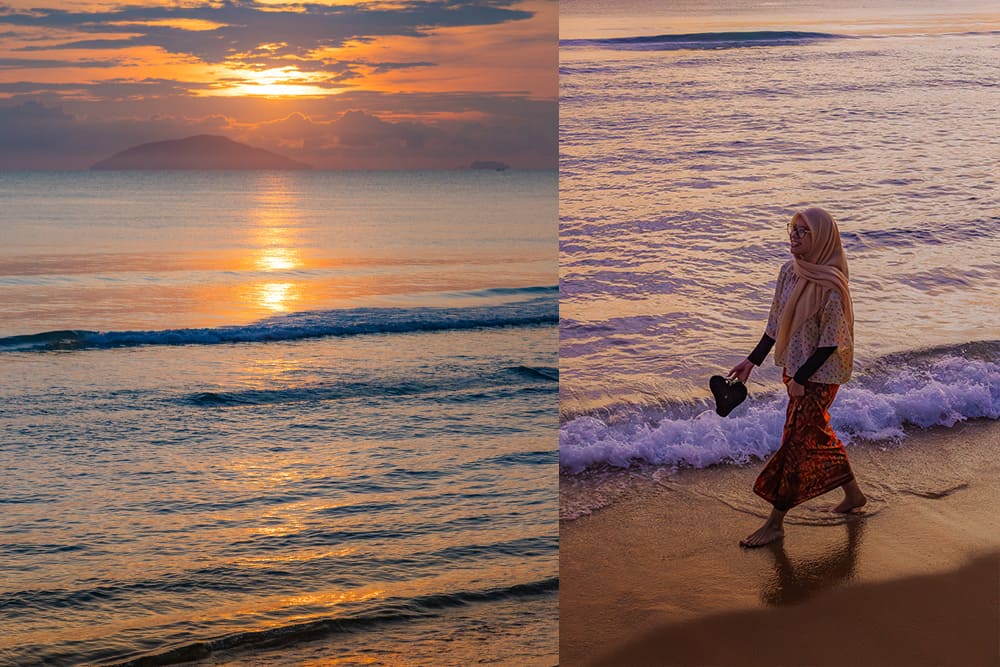
There is a particular kind of quiet that settles over Malaysia’s east coast just before dawn. The fishing boats are already out or just coming in, the sand is cool underfoot, and the horizon over the South China Sea turns from ink to violet to a thin line of gold. Because this whole stretch of coastline faces east, from Kelantan in the north down to the southern tip of Johor, it is one of the few places in the country where you can watch the sun climb straight out of the sea almost anywhere you stand.
Sunsets get most of the attention on the west coast, and rightly so. But if you have ever dragged yourself out of bed at half past six, coffee in hand, to see a red sun lift clear of the water off Terengganu, you will know the east coast has the better end of the bargain. This guide brings together the spots worth setting an alarm for, the times you can expect the sun to appear through the year, and a few practical pointers for photographing it well.
Why the East Coast Belongs to the Morning
Geography does most of the work here. The peninsula’s eastern shoreline runs roughly north to south, so the open sea lies directly in front of you as you face the sunrise. There is no mainland in the way, only the occasional island sitting on the horizon, which, as it happens, makes for a far more interesting composition than an empty line of water.
The other advantage is how gentle the coast is. Long, shallow beaches lined with casuarina trees, calm river mouths and wide lagoons all catch and reflect early light beautifully. On a still morning the wet sand at low tide becomes a mirror, doubling the colour of the sky.


Source: Hakim.Zulkifli
When Does the Sun Rise? Seasonal Sunrise Times
Malaysia sits close to the equator, so sunrise times shift far less through the year than they do in Europe. Even so, the difference between the earliest and latest sunrise on this coast is around half an hour, which matters when you are planning a shoot or a drive from your hotel.
The latest sunrises fall in late January and early February, when the sun appears at around 7.15am to 7.30am depending on how far north you are. The earliest arrive in late October and early November, at roughly 6.45am to 6.55am. There is a second, smaller dip around May and June, when sunrise hovers close to 6.55am along the entire coast.
The table below gives approximate sunrise times for key locations, calculated for Malaysian time (UTC+8). Treat them as a planning guide and confirm the exact time for your date with a reliable sunrise app before heading out.
| Location | Early February (latest) | Mid May to June | Early November (earliest) |
|---|---|---|---|
| Kota Bharu, Kelantan | 7.28am | 6.55am | 6.57am |
| Setiu and Penarik, Terengganu | 7.25am | 6.54am | 6.54am |
| Kuala Terengganu | 7.24am | 6.53am | 6.53am |
| Cherating, Pahang | 7.21am | 6.53am | 6.50am |
| Mersing, Johor | 7.17am | 6.54am | 6.47am |
| Desaru, Johor | 7.15am | 6.53am | 6.44am |
Approximate times calculated from each town’s coordinates. First light (civil dawn) begins roughly 20 to 25 minutes earlier.
That last point is worth underlining. The best colour often comes well before the sun itself breaks the horizon, so plan to be on the sand at least half an hour ahead of the published sunrise time.
The Sun Moves Along the Horizon Too
It is easy to forget that the sunrise point shifts through the year. Around the June solstice the sun comes up noticeably north of due east, while in December it rises well to the south. On a coastline scattered with islands and headlands, that shift decides whether the sun appears beside a particular island or somewhere out in open water. A quick check on a sun position app before you choose your spot can save a lot of disappointment.
Understanding the Monsoon Seasons
No sunrise guide to this coast would be complete without the monsoon. From roughly November to March, the northeast monsoon brings heavy rain, strong winds and rough seas to the east coast. Many island resorts close, boat services to places such as Redang and Perhentian are largely suspended, and several mornings in a row can pass with the horizon hidden behind cloud.
That does not mean the season is wasted. Breaks in the weather can produce some of the most dramatic skies of the year, with towering clouds catching pink and orange light. But if a clean sunrise is your priority, the drier months from around April to September generally offer steadier conditions and calmer water. Afternoon thunderstorms are common at any time of year, yet mornings are often the clearest part of the day.
The Best Sunrise Spots Along the Malaysian Coast
Pantai Cahaya Bulan, Kelantan
Just outside Kota Bharu, Pantai Cahaya Bulan is a long, open beach with a strong local flavour. Colourful fishing boats are a familiar sight along the Kelantan coast, and they make natural foreground subjects against a dawn sky. Being the most northerly spot on this list, it also has the latest sunrises, which is a small mercy in February.


Setiu, Penarik and Merang, Terengganu
For many sunrise lovers, the stretch between Merang and Penarik in northern Terengganu is the sweet spot. The beaches here are long, quiet and largely undeveloped, backed by the Setiu Wetlands, a network of lagoons, estuaries and mangroves that turns silver and gold in the first light. Look out to sea on a clear morning and you can pick out the silhouettes of Redang and the Perhentian islands on the horizon, which gives your photographs a sense of depth that a plain sea view cannot.
The practical challenge is that this coast has relatively few places to stay right on the sand, and sunrise is far more enjoyable when you do not have to drive in the dark. Beachfront villas such as Katsetiu Villas in Setiu sit a short walk from the shore with views across to Redang and the Perhentians, so you can step out of the door as the sky starts to glow. Merang Jetty is also close by, which makes it easy to pair a dawn on the beach with a day trip to the islands.


Source: faz.ashary, aazmeeriskndr
Batu Buruk, Kuala Terengganu
If you are based in the state capital, Batu Buruk is the easy option. It is a city beach, so expect joggers, families and early morning walkers rather than solitude, but the atmosphere is part of the appeal. The sun rises straight over the sea here and the wide promenade is accessible even if you are short on time.


Source: Hakim.Zulkifli
Kemasik, Terengganu
Further south, between Dungun and Kerteh, Kemasik Beach is known for its rocky outcrops scattered along an otherwise sandy shore. Rocks are a gift for sunrise photography, adding texture, shape and something to anchor the frame. Check the tide times before you go, since the character of the beach changes considerably between high and low water.


Cherating and Teluk Cempedak, Pahang
Cherating has long been a favourite with surfers and backpackers, and its curving bay lends itself to relaxed, unhurried mornings. Closer to Kuantan, Teluk Cempedak offers a different setting with a headland and boardwalk framing the beach. Both are easy to reach and have plenty of accommodation to choose from.


Mersing and Desaru, Johor
In the south, Mersing is the gateway to Tioman and the islands of the Johor archipelago, several of which break up the horizon beautifully at dawn. Desaru, with its long beach and resort strip, rounds off the coast and enjoys the earliest sunrises on this list in late October and November.


Photography Tips for East Coast Sunrises
A great sunrise photograph starts before the sun comes up. Arrive during blue hour, when the sky shifts from deep blue to warmer tones, and give yourself time to find a composition rather than rushing once the colour arrives.
Foreground is what turns a pleasant sunrise into a memorable image. Fishing boats, driftwood, rocks, footprints or the reflective sheen of wet sand at low tide all work well. Place the horizon deliberately, usually on the lower third when the sky is doing the talking and the upper third when the reflections are stronger.
The contrast between a bright sky and a dark beach is difficult for any camera. Bracketing several exposures and blending them later is one solution; a graduated neutral density filter is another. On a phone, tapping to expose for the sky and letting the foreground fall into silhouette often produces a cleaner, more striking result than trying to capture everything at once.
A tripod helps enormously in the low light before sunrise, and it allows you to use slower shutter speeds to smooth out the waves into a soft haze. If you are shooting handheld, brace yourself against something solid and keep an eye on your shutter speed.
Humidity is the quiet enemy on this coast. Carrying a cold camera straight from a room cooled by air conditioning into warm, damp morning air will fog the lens almost instantly. Let your gear sit in its bag outside for a while before you need it, and bring a soft cloth for salt spray. Rinsing sand from your tripod legs afterwards will also help it last longer.
Finally, do not pack away too quickly. The minutes after the sun clears the horizon often bring golden side light across the beach, long shadows and fishermen hauling in their boats, all of which make for strong images of their own.
Planning Your Own East Coast Sunrise
A few habits make every sunrise outing smoother. Check the forecast and cloud cover the night before, and keep an eye on the sea conditions during the monsoon months, when swimming and boat trips may be unsafe. Confirm the sunrise time and direction for your exact date and location. Pack water, insect repellent and a light layer, because early mornings on the beach can feel cooler than you might expect. And above all, stay somewhere close enough that the walk to the shore is a pleasure rather than a chore.
A Coast Made for Early Risers
Watching the sun rise over the South China Sea is one of those simple experiences that rarely disappoints, even on the mornings when the clouds refuse to cooperate. The east coast rewards anyone willing to trade an hour of sleep for a horizon full of colour, whether that is among the fishing boats of Kelantan, on the quiet sands of Setiu, or in the rocky coves further south.
Choose your season, check your times, find a spot with an interesting foreground and give yourself plenty of time before first light. Do that, and the sea will do the rest.