
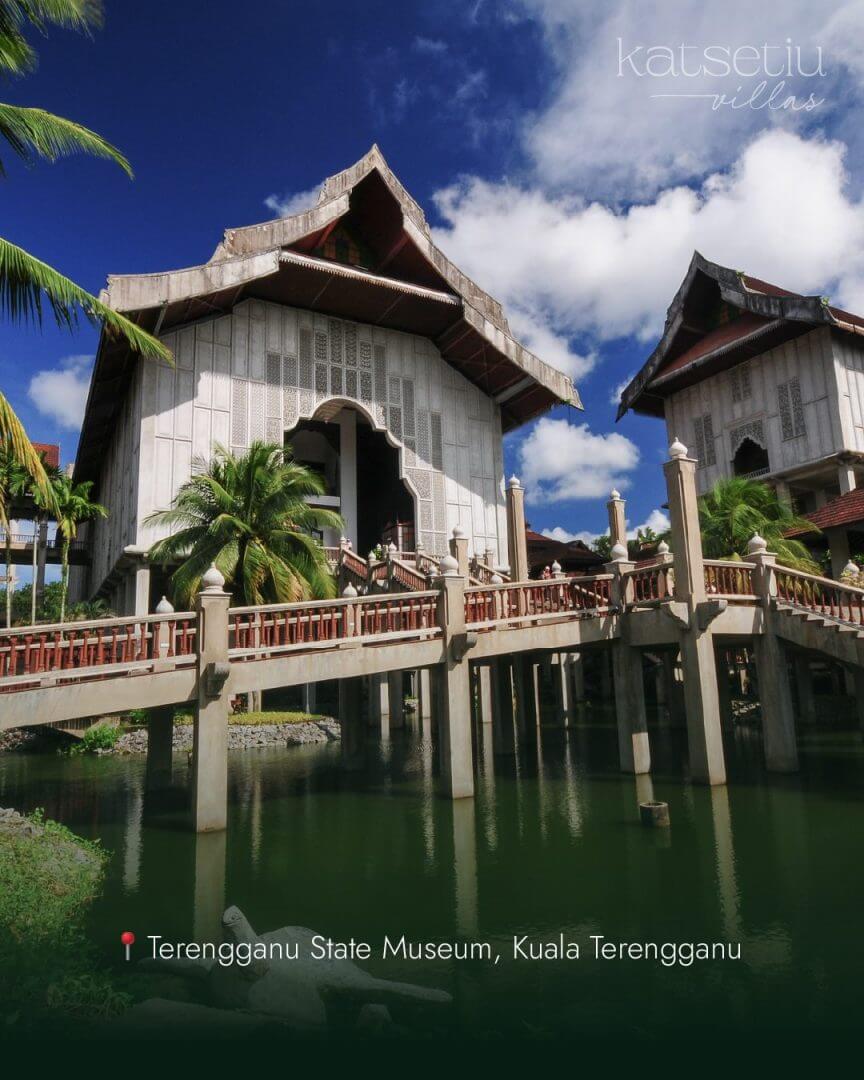
Terengganu is one of Malaysia’s most captivating states, home to the longest coastal beach stretch facing the South China Sea and 16 turquoise crystal-clear islands, weaved by centuries-old Malay traditions dating to 1750 with the rustic charm of untouched fishing villages and coupled with a laid-back beach vibe that complements your idea of slow travel. This state has naturally positioned itself as a compelling charming staycation and a beach holiday destination for travelers, explorers, divers and local tourists.
Known officially as Terengganu Darul Iman (“Terengganu, Abode of Faith”), the state blends deep-rooted heritage with some of Southeast Asia’s most photogenic beaches, making it a top destination for travelers seeking authentic Malaysian experience beyond Langkawi, Kuala Lumpur and Penang.
Some say Terengganu is a quiet state, boring but most travelers appreciate the less populated districts, silence and tranquility – captivating beach travelers and adventure seekers – more so for those who are seeking less overcrowded touristy places in Malaysia. In this guide, we compile everything you need to know about Terengganu – the hidden gem of Malaysia’s best destination that no one talks about.
History of Terengganu
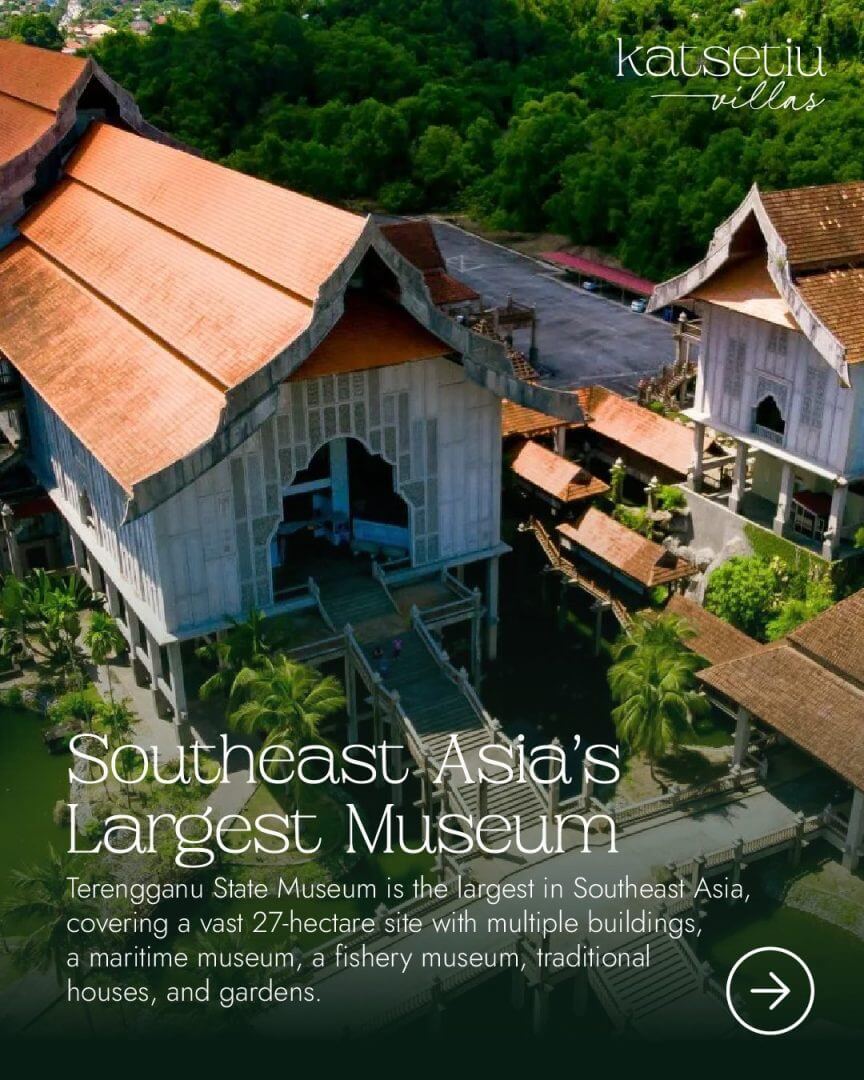
Terengganu’s recorded history stretches back over 700 years.
The Terengganu Inscription Stone (Batu Bersurat), dated to 1303 CE and considered the earliest evidence of Islam in the Malay Archipelago, was discovered in Kuala Berang, Hulu Terengganu — cementing the state’s role as an early center of Islamic learning in the region.
Long before that, Terengganu functioned as a trading outpost along the maritime Silk Road, with Chinese, Siamese, and Arab traders calling at its river mouths for pepper, gold, and forest produce. The state emerged as an independent sultanate in 1725 under Sultan Zainal Abidin I, breaking away from Johor’s sphere of influence, and it developed a distinct royal lineage that continues to this day under the Terengganu royal house based in Kuala Terengganu.
During the colonial era, Terengganu came under Siamese suzerainty before being transferred to British influence through the 1909 Anglo-Siamese Treaty, becoming one of the “Unfederated Malay States.” Unlike the Federated Malay States, Terengganu retained a greater degree of autonomy, which helped preserve its unique dialect, customs, and monarchy. The state endured Japanese occupation during WWII before joining the Federation of Malaya in 1948 and subsequently independent Malaysia in 1957.
In more recent history, Terengganu’s coastline played a humanitarian role in the late 1970s and 1980s when Pulau Bidong became a refugee camp sheltering tens of thousands of Vietnamese boat people — a chapter still remembered through a small memorial on the island today. The discovery of offshore petroleum reserves in the 1970s then transformed Terengganu’s economy, ushering in the oil and gas era that still defines much of the state’s modern development.
Land Size and Geography
Terengganu covers approximately 13,035 square kilometres, making it a mid-sized Malaysian state. Geographically, it is split into two distinct zones:
- Coastal plains – a narrow, densely populated strip running along the South China Sea, home to most towns, fishing villages, and the majority of the state’s roughly 1.28 million residents.
- Terengganu Highlands – a mountainous, forested interior stretching from the Kelantan border down to Kemaman, peaking at Gunung Lawit (1,519 metres), the state’s highest point.
Terengganu holds the distinction of having the longest coastline in Peninsular Malaysia, dotted with river estuaries, mangrove wetlands (most notably the Setiu Wetlands), and dozens of offshore islands. The state comprises eight administrative districts: Kuala Terengganu, Kuala Nerus, Marang, Setiu, Besut, Hulu Terengganu, Dungun, and Kemaman.
Economic Activities
Terengganu is known for its oil and gas activities, and marine resources but its economy rests on several key pillars:
- Oil and gas is the single largest contributor to state GDP. Kemaman and Kerteh host major petrochemical hubs, refineries, and offshore support bases tied to Petronas operations in the South China Sea, alongside a substantial network of oilfield services and downstream industries.
- Fisheries and marine resources remain a traditional backbone of the coastal economy, with Terengganu long ranked among Malaysia’s top fish-producing states. Kuala Terengganu and Chukai host major fishing ports supplying both domestic markets and export-grade seafood processing.
- Tourism has grown into a critical revenue stream, anchored by island resorts (Redang, Perhentian, Lang Tengah, Kapas), eco-tourism at Tasik Kenyir and Setiu Wetlands, and cultural heritage attractions in Kuala Terengganu. Homestays, dive operators, and boutique beach villas — particularly around Merang, Marang, and Setiu — have expanded rapidly to serve both domestic and international travelers.
- Agriculture and cottage industries contribute through padi cultivation in Besut, coconut and rubber smallholdings, and traditional craft industries — songket weaving, batik, brassware (tekat), and keris-making — that also feed into tourism-linked retail.
- Public sector and education round out the economy, with Universiti Malaysia Terengganu (UMT) and several polytechnic and vocational institutions anchoring employment in Kuala Terengganu and Kuala Nerus.
Major Attractions
Terengganu may not be a boring destination as it offers quite an array of tourist attractions, from nature adventure travel to traditional charms and other historical attractions.
- Kuala Terengganu Waterfront & Chinatown (Kampung Cina) – riverside promenade, heritage shophouses, and the iconic Drawbridge (Jambatan Angkat)
- Islamic Heritage Park (Taman Tamadun Islam) – scaled replicas of the world’s great mosques on Pulau Wan Man
- Tasik Kenyir – Southeast Asia’s largest man-made lake, offering houseboats, jungle trekking, waterfalls, and freshwater fishing
- Setiu Wetlands – a globally significant mangrove and lagoon ecosystem, home to terrapins, otters, and migratory birds
- Redang, Perhentian, Lang Tengah, and Kapas Islands – premier diving and snorkeling destinations with coral reefs and marine parks
- Crystal Mosque and Islamic Civilization Park, Kuala Terengganu
- Rantau Abang – historic nesting ground of the leatherback turtle
- Kemasik Beach, Kemaman – dramatic rock-and-sand coastline, one of Malaysia’s most photographed beaches
- Bukit Besi – former tin-mining town with colonial-era heritage trails
- Terrapuri Heritage Village, Setiu – traditional Malay palace-style architecture repurposed as a boutique cultural retreat
Relevant For You:
Top Best Attractions & Places in Terengganu That You Must Visit
Popular Food of Terengganu
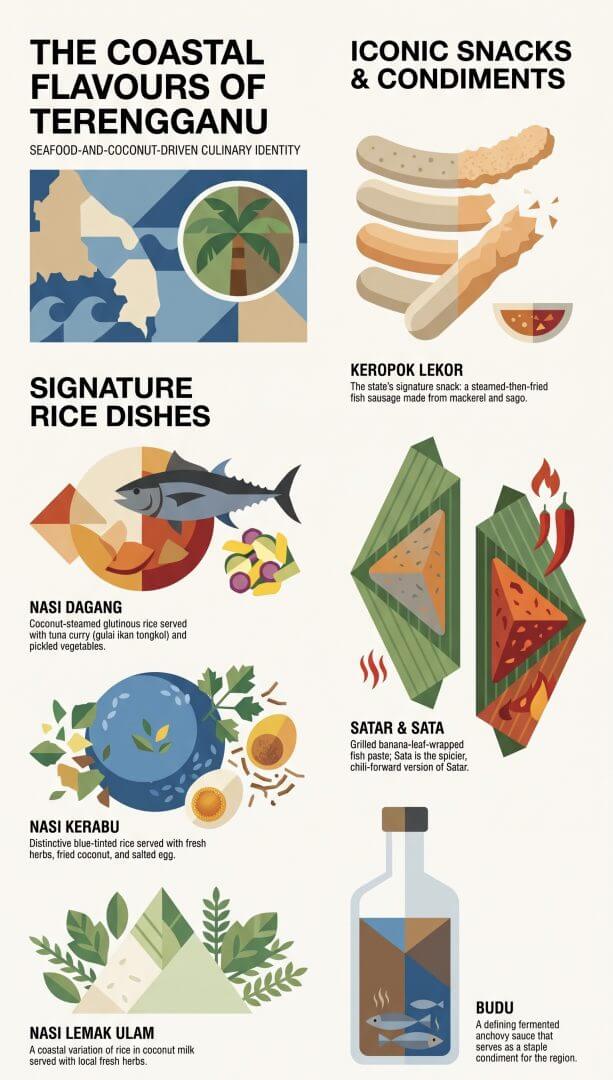
Terengganu’s cuisine is distinct even within Malaysia, rich and full of flavour – shaped by its fishing culture and coconut-rich coastal produce, here are some popular food you should try if you are visiting Terengganu:
- Keropok Lekor – the state’s signature snack, a steamed-then-fried fish sausage made from ground mackerel or sardine and sago flour
- Nasi Dagang – glutinous rice steamed in coconut milk, served with tuna curry (gulai ikan tongkol) and pickled vegetables
- Nasi Lemak Ulam – nasi lemak served with an assortment of fresh local herbs
- Satar – grilled fish paste wrapped in banana leaf, seasoned with turmeric and coconut
- Sata – a spicier, chili-forward cousin of satar
- Budu – a fermented anchovy sauce, a defining condiment of Terengganu-Kelantan cuisine
- Akok – a rich, caramelized egg-and-coconut custard dessert
- Nasi Kerabu – blue-tinted rice (from butterfly pea flower) served with herbs, fried coconut, and salted egg, shared with neighboring Kelantan
- Keropok Sira/Keping – sun-dried fish crackers, a common household export product
Relevant For You:
The People
Terengganu is one of Malaysia’s most ethnically homogeneous states, with over 95% of the population being ethnically Malay. The remaining population includes Chinese (predominantly Hokkien-speaking Peranakan communities known locally as “Mek Awang”), Indians (mostly Tamil), Siamese communities near the Kelantan border, and small Orang Asli groups (Batek and Semaq Beri) in the interior highlands.
Two distinct Malay sub-groups exist within the state: Terengganu Malays, who form the majority across most districts and speak the distinctive Terengganu Malay dialect, and Besut Malays in the north, who are linguistically and culturally closer to Kelantan and speak Kelantan-Pattani Malay. According to the 2020 census, the population is 97.3% Muslim, 2% Buddhist, 0.2% Hindu, and 0.2% Christian.
However, the Malays in Terengganu are very welcoming to foreign visitors and international travelers. Often visitors commented on the warmth of the locals – mostly helpful to travellers as majority of them understands (and can communicate) basic English.
Local Culture
Terengganu’s culture is deeply tied to its Islamic heritage, seafaring traditions, and royal court history. The Terengganu Malay dialect — with its unique vocabulary, intonation, and expressions — is a strong marker of local identity and largely unintelligible to standard Malay speakers unfamiliar with it, with close resemblance to the Kelantanese dialect.
Traditional performing arts remain vibrant, including Ulek Mayang, a ritual dance said to invoke sea spirits for the safety of fishermen, and Rebana Ubi, giant ceremonial drums historically used to announce events or rally villagers. Wau (giant kite) making and flying is another cultural hallmark, alongside gasing (top-spinning) competitions.
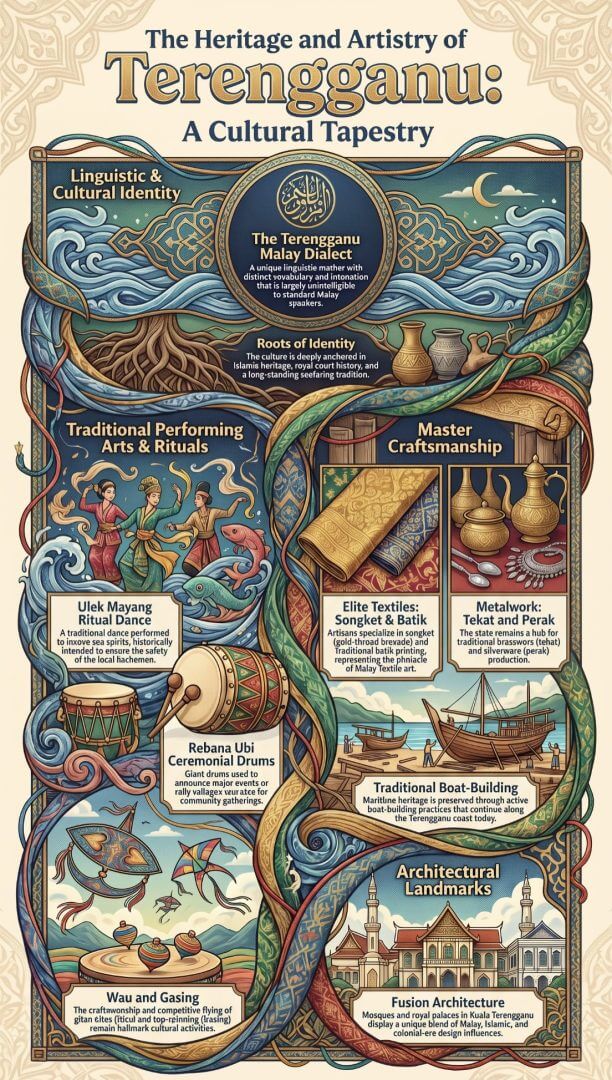
Craftsmanship is central to Terengganu identity: songket weaving (gold-thread brocade textiles), batik printing, brass and silverware (tekat and perak), and traditional boat-building along the coast are all still actively practiced and passed down through generations. The state’s mosque architecture and royal palaces, particularly in Kuala Terengganu, reflect a blend of Malay, Islamic, and colonial-era design influences.
Major International Events
Terengganu draws major international events from the monsoon cup race, trialthlon, half marathon and other eco-tourism events that draws international and local visitors each year. Some of the events that are worth going in Terengganu are as follow:
- Monsoon Cup – Malaysia’s premier international match-racing sailing event, held annually in Kuala Terengganu/Duyong waters since 2005, drawing top world sailing teams during the monsoon season
- Kenyir International Half Marathon / Kenyir Triathlon – international endurance sporting events set around Tasik Kenyir
- Terengganu International Squid Jigging Festival – a fishing-tourism festival promoting the state’s marine industry
- Setiu Wetlands International Bird Race / eco-tourism events – drawing birdwatchers and conservationists from across the region
- International Sailing and Watersports Festivals tied to the Monsoon Cup calendar, hosted around the Duyong waterfront
Coastal Beaches of Terengganu
With more than 240km coastline, there are 23 coastal beaches you can explore in Terengganu. The state’s longest stretch of panoramic, unpolluted coastline runs along the South China Sea from the Besut district in the north down to the Kemaman district in the south, making it the longest stretch of exotic beach in Malaysia.
Most of the top best beaches in Terengganu are open to public, with easy access to public car park and most inner road facing the beach are relatively small. You could find a good selection of vacation AirBnB home rentals (homestay) on some beaches in the Setiu district, near to the Merang Jetty (if you are heading to Redang Island or Lang Tengah Island).
| Coastal Beach Name | District |
| Batu Buruk Beach | Kuala Terengganu |
| Kuala Ibai Beach | Kuala Terengganu |
| Batu Rakit Beach | Kuala Nerus |
| Rhu Rendang Beach | Marang |
| Marang Beach | Marang |
| Merchang Beach | Marang |
| Kuala Marang Beach | Marang |
| Penarik Beach | Setiu |
| Rhu Sepuluh Beach | Setiu |
| Chalok Beach | Setiu |
| Merang Beach | Setiu |
| Pantai Bukit Perah | Setiu |
| Rantau Abang Beach | Dungun |
| Tanjung Jara Beach | Dungun |
| Peranginan Batu Layar | Dungun |
| Kemasik Beach | Kemaman |
| Teluk Mak Nik Beach | Kemaman |
| Air Putih Beach | Kemaman |
| Pantai Kijal | Kemaman |
| Kuala Besut Beach | Besut |
| Pantai Bukit Keluang | Besut |
| Pantai Bukit Puteri | Besut |
Islands of Terengganu
Terengganu is home to 16 natural islands (or Pulau in Malay) surrounded by beautiful marine life. Popular islands include Redang, Lang Tengah, Kapas, Gemia, Perhentian, Tenggol, Yu and few others. Most are accessible via small speed boats operating at Government owned and private jetties (eg: Merang Jetty at Setiu, Summer Bay Lang Tengah Jetty and others).
The sheer number of islands makes Terengganu a unique beach holiday destination in Malaysia for divers from around the world, next to the mainstream touristy Langkawi Island or Penang.
| Island Name | District |
| Pulau Redang | Kuala Nerus |
| Pulau Lang Tengah | Kuala Nerus |
| Pulau Pinang (Redang Marine Park) | Kuala Nerus |
| Pulau Ekor Tebu | Kuala Nerus |
| Pulau Lima | Kuala Nerus |
| Pulau Kapas | Marang |
| Pulau Gemia | Marang |
| Pulau Kapas Kecil | Marang |
| Pulau Bidong | Kuala Nerus / Setiu waters |
| Pulau Perhentian Besar | Besut |
| Pulau Perhentian Kecil | Besut |
| Pulau Susu Dara | Besut |
| Pulau Serenggeh | Besut |
| Pulau Tenggol | Dungun |
| Pulau Kerengga | Dungun |
| Pulau Yu (Shark Island) | Dungun |
Getting to Terengganu: Travel Options By Flight and By Road
Traveling By Flight
By Flight is the fastest way to reach Terengganu from Kuala Lumpur is by air into Sultan Mahmud Airport (TGG), located about 8 km from Kuala Terengganu city centre. Direct flights from Kuala Lumpur International Airport (KLIA) and Subang’s Sultan Abdul Aziz Shah Airport take around 55 minutes to just over an hour, operated by AirAsia, Malaysia Airlines, and Firefly, with roughly 40-plus direct services running each week.
Expect to pay cheap flights to Terengganu as fares can start from as low as RM30–40 during off-peak periods (via Air Asia), and flying is by far the most time-efficient option, especially for weekend trips or when heading straight to the islands.
Traveling by Car
By Road Driving is a popular option for those who want flexibility or plan to explore multiple towns along the way. The route runs east out of Kuala Lumpur via the Karak Highway, connecting onto the East Coast Expressway (LPT1 and LPT2) all the way to Kuala Terengganu. Since LPT2 fully opened, the drive — roughly 450 km — now takes about 4.5 to 5 hours under normal traffic conditions, a significant improvement from the 7–8 hours it once took via the old federal trunk roads. The expressway is well-maintained with rest-and-service areas roughly every hour, making it comfortable for a self-drive trip, and popular detours along the way include Temerloh (famous for patin fish) and Kuantan.
By Bus For budget travellers, express buses depart from Terminal Bersepadu Selatan (TBS) in Kuala Lumpur to Terminal Bas MBKT in Kuala Terengganu, with fares starting around RM45 and journey times of 6 to 8 hours depending on traffic and rest stops.
How Many Days to Spend in Terengganu
- 2–3 days is enough for a mainland-focused trip covering Kuala Terengganu city, the Islamic Heritage Park, and a day trip to Tasik Kenyir or the Setiu Wetlands.
- 4–5 days allows time to combine the mainland with one island stay (Redang, Perhentian, Kapas, or Lang Tengah), factoring in boat transfer schedules and weather-dependent departures.
- 6–7 days is ideal for a fuller itinerary that mixes Kuala Terengganu, Marang or Merang for beach and villa stays, an island getaway, and inland attractions like Kenyir Lake — giving enough buffer for monsoon-season disruptions between November and February, when many island resorts close temporarily.
For most travellers coming from Kuala Lumpur specifically for a beach or island holiday, 5 days / 4 nights tends to be the sweet spot: enough time for one island (2–3 nights) plus a night or two on the mainland without feeling rushed.
Final Thoughts
From the ancient inscription stone in Kuala Berang to the buzzing sailing regattas at Duyong and the pristine reefs of Redang and Perhentian, Terengganu offers a rare combination of deep cultural roots and world-class natural beaches in Malaysia. This state begs you to stay at least 5 days to properly immerse yourself to natural surroundings, the charm and the laid back beach atmosphere. This makes Terengganu the best digital detox destination with more than 23 coastal beaches to relax and unwind and not forgetting 16 islands to explore if you have plenty of time.
Whether you’re drawn by its history, its food, its islands, or its people, Terengganu remains one of Malaysia’s most authentic and rewarding destinations to explore.